
- Product Name
- CasNo
- MF
- MW
- Content
- Appearance
- Packing
- Apply
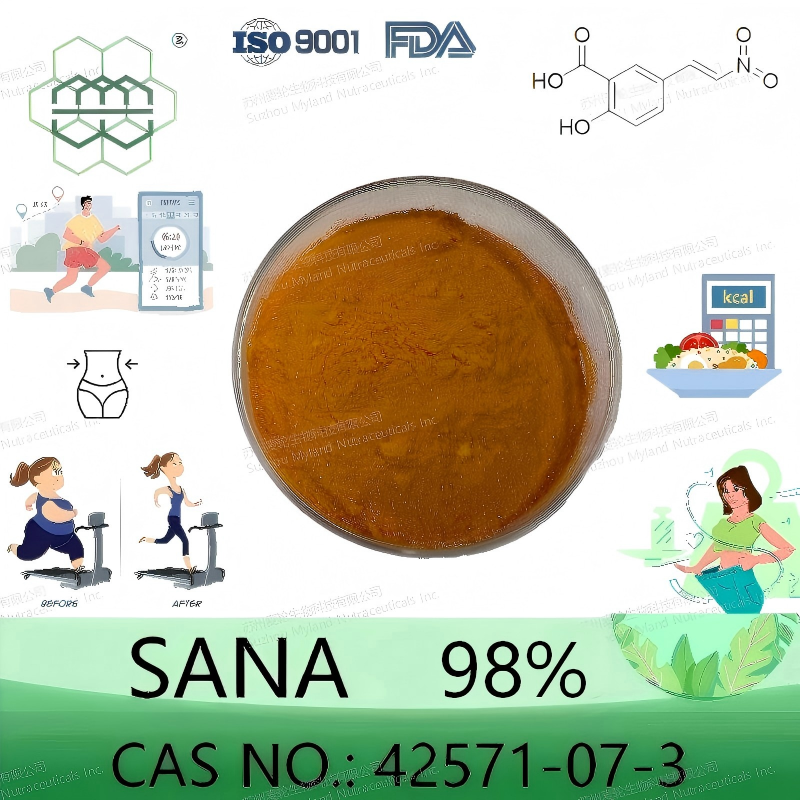
- SANA |42571-07-3 98%
- 42571-07-3
- C9H7NO5
- 209.16
- 98%
- Yellow powder
- 1kg/包;25kg/桶
- Sports Nutrition & Weight Management

Your Location:Home >51吃瓜网|吃瓜爆料网|吃瓜网官网|吃瓜入口: SANA |42571-07-3 98%
|
Product name |
SANA |
|
Other name |
(E)-2-hydroxy-5-(2-nitrovinyl)benzoic acid Salicylic acid nitroalkene |
|
CAS No. |
42571-07-3 |
|
Molecular formula |
C9H7NO5 |
|
Molecular weight |
209.16 |
|
Purity |
98% |
|
Appearance |
Yellow powder |
|
Packing |
1kg/bag, 25kg/barrel |
|
Application |
Dietary Supplement Raw Material |
Product introduction
🍌SANA is a derivative of salicylic acid, with the full name "salicyl nitroenol." Experimental studies have demonstrated that SANA specifically targets adipose tissue and activates thermogenesis through an unconventional mechanism. Thermogenesis is typically mediated by a protein called UCP1, which is present in mitochondria (the organelles responsible for cellular energy production). UCP1 can be activated under certain conditions, such as exposure to cold environments, thereby interfering with the synthesis of cellular fuel ATP (adenosine triphosphate) and leading to the dissipation of energy generated by cellular respiration as heat. In contrast, SANA operates differently: this novel drug enables adipocytes to utilize creatine—a compound derived from three amino acids (arginine, glycine, and methionine)—as an energy source for thermogenesis without involving the UCP1 protein. Consequently, it represents the first class of anti-obesity agents that does not affect the central nervous system, digestive system, or appetite. SANA targets enzymes involved in the so-called "creatinine futile cycle," a thermogenic pathway in which amino acid compounds are repeatedly converted to phosphocreatine and subsequently back to creatine, consuming ATP and releasing energy in the form of heat.
Feature
ꦛ1) Unique target mechanism: It stimulates thermogenesis by activating creatine metabolism in adipose tissue, thereby consuming energy. This represents an unconventional thermogenic pathway independent of the conventional UCP1 protein. (2) Targeted action on adipose tissue: Unlike certain previous drugs that induce systemic thermogenesis with potential risks, SANA specifically targets mitochondria in adipose tissue, exerting minimal impact on overall body temperature and demonstrating superior theoretical safety.
💦(3) Preliminary human safety validation: According to a Phase 1 clinical trial published in Nature Metabolism in 2025, SANA exhibited favorable safety profile and tolerability in humans, with positive effects on weight control and glycemic management observed after two weeks of treatment.
♕(4) Solubility: Soluble in various organic solvents, including ethanol and dimethyl sulfoxide.
Applications
1. Chemical tools: In biochemistry, they can be used to study the interaction mechanisms between enzymes and substrates or serve as positive controls to verify the reliability of enzyme activity detection systems;
2. Antitumor : The hydroxamic acid group can chelate zinc ions at the active site of MMPs, rendering them inactive and thereby inhibiting their invasiveness and metastasis;
3. Anti-inflammatory: They prevent immune cells from readily crossing vascular walls and the extracellular matrix (ECM) to reach inflammatory sites and release additional inflammatory mediators, thus controlling excessive inflammation spread.
𝓀 WANT TO PURCHASE I 我能网络推销
